Partial or Full Wraps for a Fleet
Full coverage and partial coverage are not a moral ranking. Full means the graphic owns the body. Partial means the factory color is still part of the design. A fleet can mix them if the name, the number, and the mark stay consistent. This is how to choose, how to keep a mismatched set of trucks from looking accidental, and how to stage the work so the routes do not all stop at once.
Start with fleet wraps. Related reading: fleet lettering.
Tell us the year, make and model. The quote is free, and we reply the same business day.
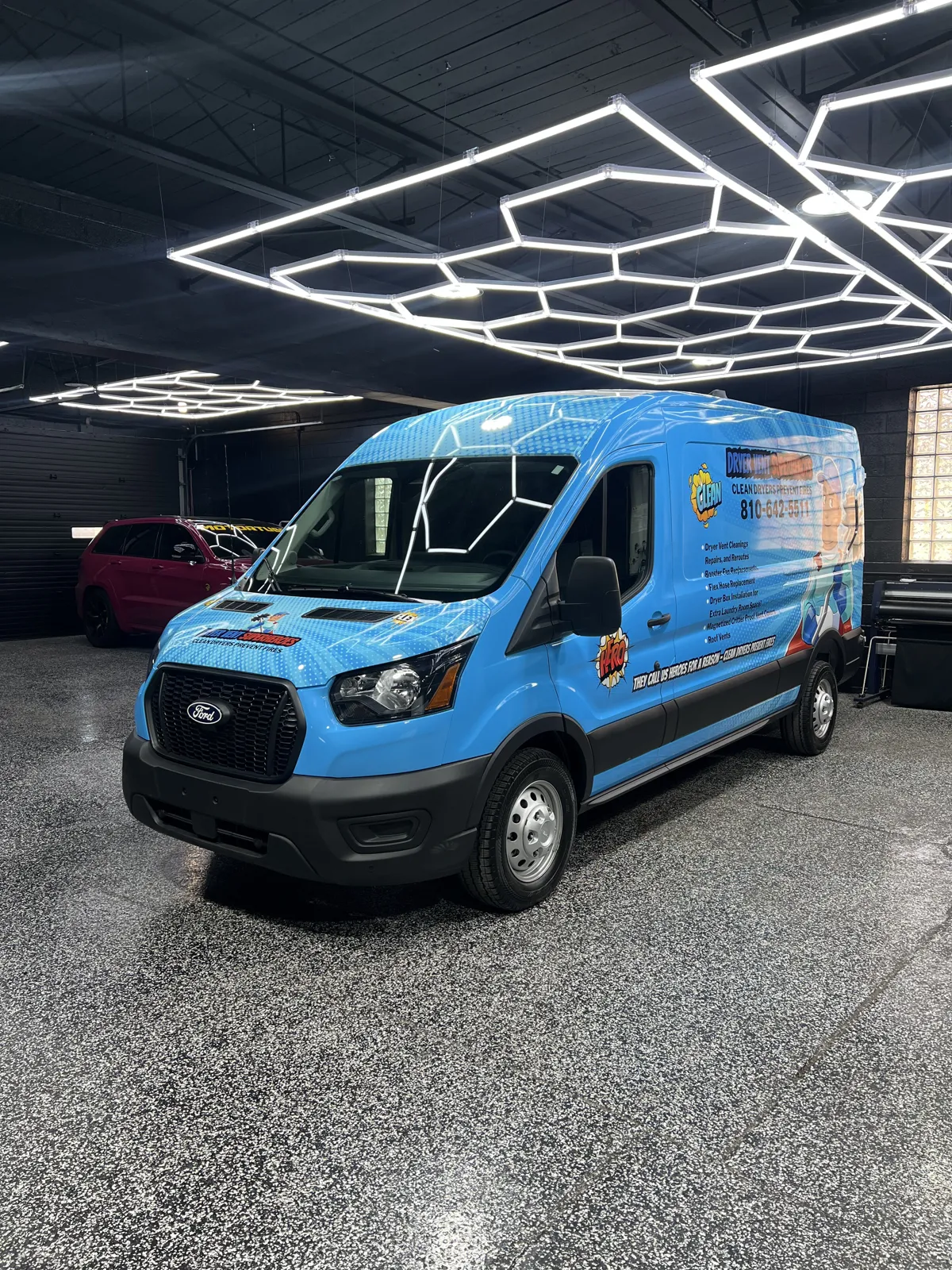
What is a partial wrap on a work vehicle?
Factory color still shows. Graphics cover a portion of the body, enough to carry the name and the offer, without printing every panel.
On a pickup the partial floor is $1,800. On a van it is $2,300. You keep some of the paint, which matters if the van is white and the brand can live with white as a background. The art has to be drawn to stop cleanly, not fade into a random edge in the middle of a door where a brush will pick at it.
A full wrap replaces that decision. The body becomes the graphic. Pickups start at $3,800, standard vans at $4,500, high roofs at $5,500. You choose full when the brand is the color, the pattern, or a photo that needs the whole wall. You choose partial when the factory color is already an asset.
Lettering is the smaller cousin, from $650, or from $1,200 with a USDOT number. It is not a partial wrap. It is type and marks. If you are a one-van company, the decision tree is lettering or a full wrap. The price reading is commercial van wrap cost.
How do you keep a mixed fleet from looking accidental?
Same type, same phone number, same mark. The amount of coverage can differ by vehicle if the mark does not.
A high-roof van, a pickup, and a sedan for the estimator will not share a wall size. Forcing a full print on the sedan because the van is fully wrapped can look loud in a way you did not intend. Letting each vehicle carry the same name, in the same place relative to the door, looks like one company. That is the standard to hold. Coverage can step down as the vehicle gets smaller.
Write the set down: which units are full, which are partial, which are lettering only. Design once. The fleet lettering page is the small end. Pickup truck wraps and van wraps are the bodies. Tell us the count so the art is built as a system.
If the trucks were bought in different years and the whites do not match, a partial wrap will show that. A full wrap hides it. That is a fair reason to go full on the odd truck and partial on the ones that already match. Say it. We will not be offended that the fleet is not a matched set.
When is full coverage worth it for every unit?
When the graphic only works if the factory color disappears, or when the vehicles are the main advertising and they sit in front of customers all day.
A pattern, a full-bleed photo, or a color that is not the factory white needs the whole panel. Stopping halfway makes the design look cropped. If that is the brand, budget the full floors and the 3 to 5 days per vehicle. Stagger the units so the routes do not all stop at once.
A partial can still pay attention on a route if the name is huge. Do not full-wrap a spare truck because the lead van was full and you want them to be twins for a photo. Twins are nice. Routes matter more. You can full-wrap the truck customers see and letter the truck that only moves parts at night.
The business-side thinking, without a fake payback chart, is how a wrap earns its keep. Use it to decide whether the extra wall is doing work, not to invent a dollar return we cannot know.
What gets in the way of a partial layout?
Racks, boxes, and handles. A partial design has less room to dodge them, so the photos of the real truck matter more.
A partial wrap that looks balanced on an empty van falls apart when a ladder rack covers the top third. Send the truck as it works. We will put the name where the rack is not. If the rack covers every good panel, lettering on the door and the rear may be the honest job, and we will say that.
Color breaks have to land on purpose. An edge in the middle of a door, where a brush can lift it, is a bad place to stop. We prefer edges that hide at a body line when the shape allows. Ask to see where the film will stop. On a white van you will see the line. That is fine if it was drawn. It is not fine if it was an accident.
Commercial wraps in Troy and the rest of the metro are installed in Madison Heights. Bring the dirtiest unit if the fleet is mixed. The clean show truck hides the problems the working truck will have.
If you already know the vehicle, send it now and we will quote that car.
Can you stage the fleet instead of doing every truck at once?
Yes. Do the truck customers see first. Keep the art file so the next unit matches without a second design invention.
A common path is lettering now, partial on the next van, full when the brand is ready for the whole wall. The floors let you see those steps. You are not locked into the biggest one because you asked a question. Tell us which unit is first and when the second has to match.
Fading is the catch. A film that has lived outside for two years will not be a perfect twin of a new roll, even in the same color. If matching matters for a photo, wrap the set closer together. If matching means the phone number is the same, time matters less.
Design quoted separately is what keeps the second and third installs from feeling like new brands. Pay for the system once. Ask us to keep the file with the job.
How do you start the quote for more than one vehicle?
List every unit, the coverage you think each one needs, and whether they should match. Photos of each body, with racks on.
The install is at 436 E 14 Mile Rd, Madison Heights, MI 48071, off I-75. Monday to Friday 10 to 6, Saturday 10 to 3. Call (248) 881-8204 or use the quote form. Financing via Affirm can split an accepted invoice. Same-day service fits lettering when the day is open. Full wraps are 3 to 5 days each, so a three-van set is a schedule, not an afternoon.
Name a person who can approve art. A fleet quote stalls when the owner, the spouse, and the office manager all have vetoes and none of them are on the email. One approver is a gift to the calendar.
Southfield companies and van wraps in Madison Heights use this door. There is not a satellite installer. The vehicle comes here.
List the vehicles and the coverage you think each one needs. We will quote them as a set, with design once if the art should match.